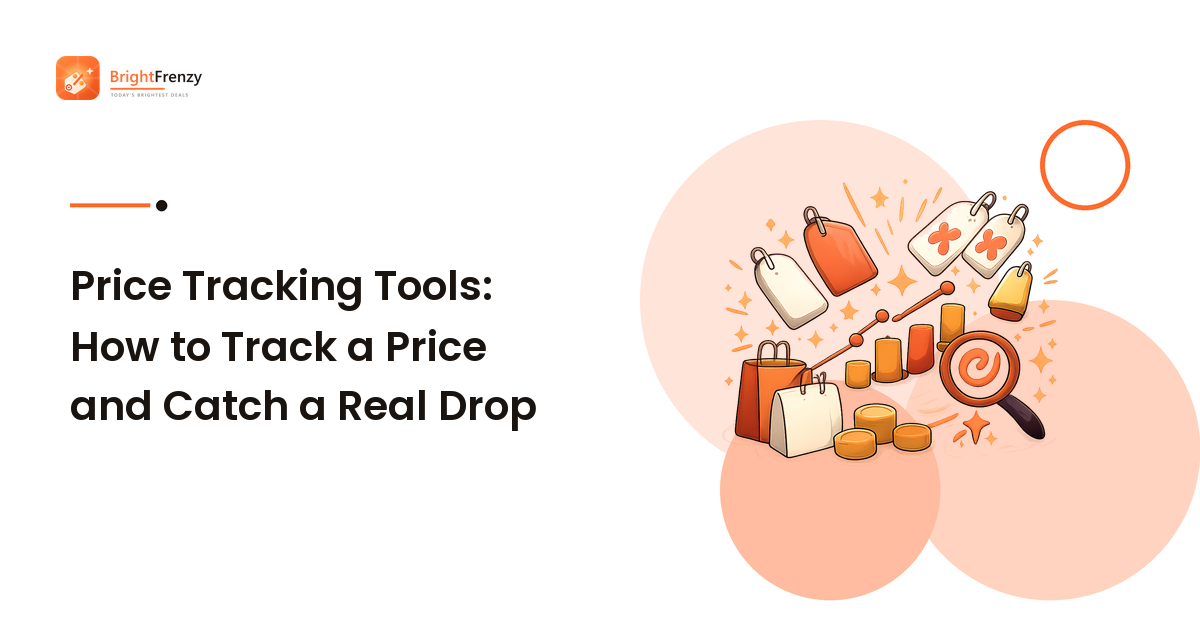
A price tracking tool records what an item has actually sold for over time and alerts you when it falls to a price you choose. That history is the deal hunter's evidence base: it replaces the struck-through "was" price with a record of reality, so you can tell a genuine drop from a routine sale badge.
Most shopping mistakes aren't caused by missing a deal — they're caused by not knowing what the item normally costs. A tracker solves exactly that, then does the waiting for you.
What does a price tracking tool actually do?
Under the hood, trackers do three jobs, and knowing which one you need decides which tool suits you.
- It samples the price. The tool checks a product page on a schedule and stores what it finds. Do that for months and you have a price history — a line showing resting price, dips, and spikes.
- It watches for a threshold. You name a target price; when a sample lands at or below it, you get an alert instead of checking daily.
- It compares across sellers. Comparison engines follow the same item across many shops at once and show today's spread.
Those are three genuinely different tools lumped under one label — "tell me when this drops", "who has it cheapest right now", and "what is this item's real normal price?" Serious deal hunters use all three, at different moments of the same purchase.
Which type of price tracking tool do I need?
| Tool type | What it answers | Best used | Main catch |
|---|---|---|---|
| Price-history checker | "What has this really cost over past months?" | Before setting a target price | Often covers one retailer only |
| Price-drop alert | "Has my item hit my number yet?" | The waiting phase, on want-list items | Fires on a sampled price — stock, shipping and fees still need checking |
| Comparison engine | "Who sells this cheapest today?" | When you're ready to buy | Partial coverage; often funded by merchant fees |
| Retailer wish list | "Has the shop itself cut this?" | Items sold in one place only | Notifies on the shop's terms, and nudges you to buy there |
| Curated deal feed | "What genuine drops happened today?" | Scanning without watching everything | Only as good as its verification and expiry data |
If you only adopt one, make it the price-history checker. Alerts are convenient; history is what makes you hard to fool — it turns our real-deal playbook from a set of principles into something you can prove on a chart.
How do I read a price history chart?
The instinct to hunt for "the lowest point ever" is the wrong one. Read the chart for shape instead — four shapes cover almost everything you'll meet.
- A flat line with occasional dips. The flat part is the true normal price, and the depth of past dips tells you what target is realistic to wait for.
- A sawtooth that never rests at the high price. If the item spends most of its life "on sale" and only briefly touches the higher number, that number isn't a price — it's an anchor. The classic signature of the inflated "was" price we take apart in how to spot fake discounts.
- A staircase stepping down over months. Typical of gadgets and anything with model years: the price ratchets down as a successor approaches. Waiting is usually rewarded.
- A rise, then a "discount". When a listed price climbs shortly before a big retail event and is then cut back to roughly where it started, the sale is arithmetic, not generosity.
One honest limit: history proves what a price did, never what it will do. Use it to set a fair target, not to time the floor.
How do I set a price alert that's actually useful?
Set an alert too low and it never fires; too high and every routine sale pings you until you mute it. A five-step routine fixes both.
- Add the item to your want-list first. An alert on something you never wanted is just an advert with better timing.
- Pull the history before naming a number. Find the resting price and the depth of typical dips. That's your evidence, and it takes a minute.
- Set your target inside the realistic dip range, not at the all-time low. Chasing a record price is how people wait months and pay more.
- Track the exact variant. Colour, size, capacity, and pack size are separate listings with separate prices.
- Give it a review date. Re-check every couple of months — prices drift, successors launch, and a stale target quietly becomes a bad one.
Then let it run. The alert buys back your attention: the tracker watches, you stop checking, and the decision only reaches you when it's worth making.
Are price tracking tools free, and how do they make money?
Most consumer trackers are free, which raises the fair question of who's paying. Usually one of four models:
- Affiliate commission — the tool earns when you click through and buy. Legitimate, but coverage can skew toward merchants with an affiliate programme, so the "cheapest" shop shown may be the cheapest among partners.
- Merchant listing fees — engines that charge for placement show a market of paying merchants, not the whole market.
- Data — shopping-behaviour data has value to retailers. Read the privacy policy of anything that lives in your browser and sees your carts.
- Paid tiers or ads — the most straightforward model, usually with the fewest incentive conflicts.
For transparency: BrightFrenzy runs on the first model — we may earn an affiliate commission when you buy through a deal link, plus ads and clearly labelled sponsored placements. It never changes which offers we verify or how we rank them. Any tool should be equally plain about its funding; if you can't find the answer in a minute, treat its rankings as advertising.
How do I verify a tracked price drop before buying?
An alert is a lead, not a verdict. Six checks, under a minute:
- Open the live listing. Sampled prices lag; the page is the truth.
- Confirm the variant matches the one you tracked.
- Check who's selling. On marketplaces, a low price often belongs to a third-party seller you'd never buy from at full price.
- Take the total to the payment page. Shipping, fees and minimum-order thresholds routinely eat a modest drop.
- Check the stack. A code or cashback route may apply on top — order matters, and one can void another.
- Ask the want-list question. Did I want this before the alert arrived? If not, close the tab; the tracker still did its job.
Do I still need a tracker if I know the sale calendar?
Yes — they answer different questions. Sale cycles tell you when a category is likely to move, the rhythms we map in when things go on sale. A tracker tells you whether your item actually moved, and by how much against its own history. Together: know the season, set the target, let the alert decide the day.
FAQ
What is the best price tracking app?
The best one covers the retailers you actually shop and gives you real price history, not just an alert. Judge any tracker on three things: how far back its history goes, whether it tracks the exact product variant, and how clearly it discloses how it makes money. A tool with shallow history and loud "lowest price!" badges is a shopping prompt wearing a tracker's clothes.
Can price trackers predict when a price will drop?
No, and be sceptical of any that imply otherwise. Trackers record the past; projecting from it is an educated guess, not a forecast. What history genuinely gives you is a realistic target price and the confidence to wait for it — more useful than a prediction, because it works whether or not the drop arrives.
Are browser price-tracking extensions safe to install?
They can be, but they're unusually privileged software: an extension that reads product pages can typically see your browsing and your carts. Before installing, check who publishes it, what permissions it requests, what its privacy policy says it collects, and how it earns. Prefer identifiable companies with a clearly stated business model, and remove anything that changes hands or quietly expands its permissions.
Why does a tracker show a different price than the shop?
Trackers sample on a schedule, so their number can be hours old. Prices also vary by region, currency, delivery address, membership status, and seller on the same listing. Treat the tracker's figure as a signal to go look, and let the live cart total be the number you decide on.
Is price history reliable evidence that a discount is real?
It's the strongest evidence a shopper can get, with two caveats: history usually covers one retailer, so it says little about whether a competitor is cheaper, and it can't see account-specific pricing. Combine history with a quick cross-store check and you've established the reference price honestly — which is exactly what a struck-through number never does.
Set your target, then let the hunt come to you. When your alert fires, check it against today's verified deals on BrightFrenzy — real prices, real expiry dates, offers checked before they're badged.