Everything on your list feels urgent, so you spend the day reacting — answering the loudest message, chasing the nearest deadline — while the work that would actually change things never gets touched. The Eisenhower Matrix fixes that by forcing one honest question about every task: is this important, or just urgent? Those aren't the same, and confusing them is why busy days so often add up to nothing.
The takeaway up front: sort each task into one of four boxes by urgency and importance, then act by the box — do the urgent-and-important now, schedule the important-but-not-urgent, delegate the urgent-but-unimportant, delete the rest. The power isn't the grid; it's that sorting forces you to protect the quiet, important work instead of letting mere urgency run your day.
What the Eisenhower Matrix actually is
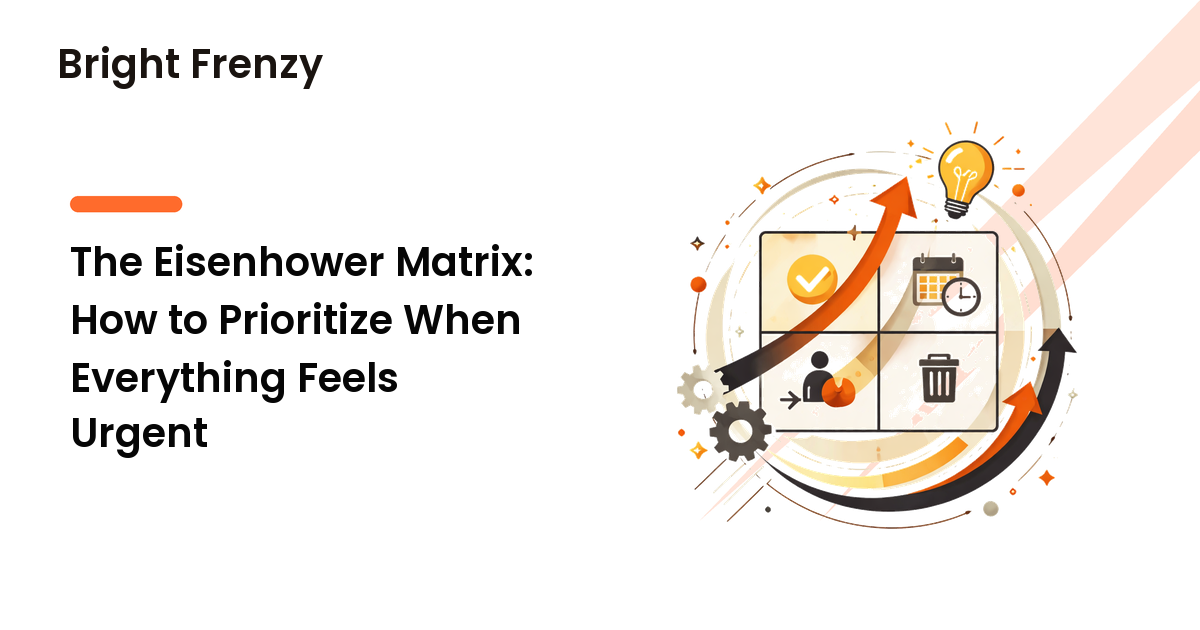
The Eisenhower Matrix — also called the urgent–important matrix — is a 2x2 grid for deciding what to work on. You rate each task on two separate questions and let the answers drop it into a quadrant that tells you how to handle it.
The idea is older than the grid — traced to Dwight D. Eisenhower, who split his problems into "the urgent and the important," and later popularized by Stephen Covey. It lasts because two words we treat as synonyms pull in opposite directions:
- Urgent means a task demands attention now — it's tied to a deadline or someone else's timeline, and it's loud: a ringing phone, a "send this in five minutes," a red badge. Urgency is about time.
- Important means a task moves you toward what matters — your goals, health, best work. Its payoff sits in the future, so it stays quiet; nothing forces you to do it today. Importance is about outcomes.
The trap: urgent things announce themselves and important things don't, so without a filter your attention defaults to the loudest task, not the one that counts. Behavioral research even describes an "urgency effect" — a pull toward tasks with a ticking clock even when a less pressing one is worth more. The matrix is that missing filter.
The four quadrants, decoded
Every task lands in one quadrant, and each carries a default action — knowing the action is the whole point.
| Quadrant | Urgent? | Important? | What lives here | Do this |
|---|---|---|---|---|
| Q1 | Yes | Yes | Real crises, hard deadlines today, things that just broke | Do it now |
| Q2 | No | Yes | Planning, deep work, health, learning, prevention | Schedule it |
| Q3 | Yes | No | Most notifications, many "quick" requests, some meetings | Delegate or trim |
| Q4 | No | No | Busywork, doomscrolling, aimless inbox-refreshing | Delete it |
- Q1 — Do. Urgent and important. Handle these now — but keep Q1 small, because living here is nonstop firefighting, the fast lane to burnout.
- Q2 — Schedule. Important but not urgent — and the quadrant everyone neglects. Nothing forces these today, so they get postponed until neglect turns them urgent. Give Q2 a slot before the urgent stuff claims the day; this is where the method earns its keep.
- Q3 — Delegate or trim. Urgent but not important to you. They feel productive because they're loud, but they serve someone else's priorities. Hand them off, batch them, and stop mistaking "responsive" for "effective."
- Q4 — Delete. Neither urgent nor important — the busywork you reach for to dodge hard things. A little real downtime is fine; just notice when Q4 eats the hours Q2 needed.
One line to remember: urgency decides when, importance decides whether. Q3 is the great deceiver — it wears the costume of Q1.
How to run the matrix in five steps
You can do this on paper in ten minutes — weekly for the big picture, and a quick pass each morning.
- Brain-dump everything. Get every task and nagging "I should…" onto one list. You can't sort what's still swirling in your head.
- Ask the two questions, in order. For each item: is it important — does it move a real goal? Then is it urgent — is there a genuine deadline? "Someone wants a reply" is not the same as important.
- Drop each task into a quadrant. Don't agonize; your first instinct is usually right, and you can move things as reality shifts.
- Act by quadrant, not by mood. Do Q1 now, calendar-block Q2, delegate or batch Q3, cross out Q4. The calendar step matters most: an important task with no time attached is just a wish.
- Review and re-sort weekly. Priorities drift. Watch for Q2 items sliding toward Q1 — that drift is your early warning for the next avoidable crisis.
A fast gut-check while you sort:
- Is this in Q1 because it's a true emergency — or because I let a Q2 task rot until it caught fire?
- What single Q2 task, done this week, would make everything else easier?
A real example: one freelancer's messy Monday
You're a freelance designer opening a chaotic Monday list. Sorted through the matrix:
- Client's site is down before their launch → Q1. Do it now.
- Draft next quarter's marketing plan for your own business → Q2. Block 90 minutes Wednesday.
- Reply to three "just checking in" emails → Q3. Batch into one 15-minute slot; don't let them shred your morning.
- Tweak your portfolio font for the fourth time → Q4. Delete — that's polishing to avoid the plan.
Notice the inversion: the loudest items were Q3, while the quiet task that actually grows the business was the Q2 work most at risk of never happening. Surfacing that flip is the whole value. Once your Q2 work has a slot, the next move is defending it — which is exactly what time blocking is for.
Why Q2 is where your leverage lives
Take one idea from the matrix: the important-but-not-urgent quadrant holds your leverage, and it's the first thing squeezed out of a busy week. Every big goal — the side project, the fitness, the skill that doubles your rate — is a Q2 investment with no deadline pushing it. Neglect it and it doesn't stay quiet; it decays into Q1, as the unwritten plan becomes a panicked all-nighter and the skipped maintenance becomes an outage.
So the real skill isn't sorting — it's spending more of your week in Q2 on purpose, manufacturing fewer Q1 emergencies later. For anyone with more drive than time, that's the whole game: point your energy at the quiet work that compounds, not the loud work shouting today.
Where the matrix falls short (and what to reach for)
The Eisenhower Matrix is a decision filter, not a full system. It's fair to name where it strains:
- "Important" is subjective. The grid only works if you're clear on your goals; otherwise everything drifts into "important." Set priorities first, then sort.
- It doesn't schedule. It tells you what deserves time, not when you'll do it — you still have to calendar the Q2 work.
- Everything can feel like Q1. If the whole list looks urgent-and-important, question your deadlines, not your workload.
- It's clumsy for fine ranking. Four boxes can't order twenty tasks that are all important.
For that last case, pair or swap it with a method that fits — each with a trade-off:
- A simple 1–2–3 priority list — best for a single day's handful of tasks, when four quadrants is overkill. Trade-off: no urgent/important split, so it's easy to rank by loudness.
- MoSCoW (Must/Should/Could/Won't) — best for scoping a project or negotiating what ships. Trade-off: built for features and stakeholders, not a daily to-do list.
- Eat-the-frog (hardest important task first) — best as a daily tie-breaker once the matrix has surfaced your Q2 work. Trade-off: it picks one task, not a system.
Use the matrix as your weekly filter for what deserves attention, and layer a finer method on top only when you need to order what survives.
FAQ
What's the difference between urgent and important? Urgent means a task needs attention now, usually from a deadline or someone else's timeline — it's loud. Important means it moves you toward a real goal, with a payoff in the future, so it's quiet. Many tasks are urgent without being important (most notifications); the most valuable work is often important without being urgent (planning, deep work). Telling them apart is the point of the matrix.
Which quadrant should I spend most of my time in? Q2 — important but not urgent. It holds planning, deep work, learning, health, and prevention: the investments that drive everything yet have no deadline forcing them. More time in Q2 means fewer Q1 emergencies, because you handle things before they catch fire.
Is the Eisenhower Matrix the same as a to-do list? No. A to-do list captures what to do; the matrix decides what deserves your time and what to ignore, delegate, or delete. Brain-dump onto a list, then run it through the matrix so the important work rises and busywork gets cut.
What if every task feels urgent and important? That usually means your deadlines are fuzzy or your goals aren't defined, so everything defaults to Q1. Pressure-test each "urgent" (what happens if it waits a day?) and each "important" (which goal does it serve?). Most lists deflate fast, and the survivors are your real priorities.
Stop letting the loudest task win
Urgency will always shout; importance rarely does. The Eisenhower Matrix just makes you listen to the quiet one on purpose. Grab your list, ask the two questions — important? urgent? — and drop every item into a box. Then guard your Q2 time like the appointment that decides your year, because it quietly is. For more no-nonsense systems that turn restless energy into finished work, explore Bright Frenzy — and put your first Q2 block on the calendar before you close this tab.