You make a hundred good calls before lunch, then order takeout again, skip the workout, and rubber-stamp something you'd have pushed back on at 9am. That isn't laziness or a willpower flaw — it's decision fatigue, and once you see the pattern you can stop fighting it and design around it.
The takeaway up front: your capacity to make good decisions is a finite resource that drains as you spend it, and most people burn it on trivia. Every choice — what to wear, which email to answer first, where to eat — draws from the same well. Make too many decisions and the well runs low, so by the time the ones that count arrive, you default to whatever is easiest. The fix isn't more discipline. It's spending fewer decisions on things that don't matter, so the ones that do get your sharpest self.
What decision fatigue actually is
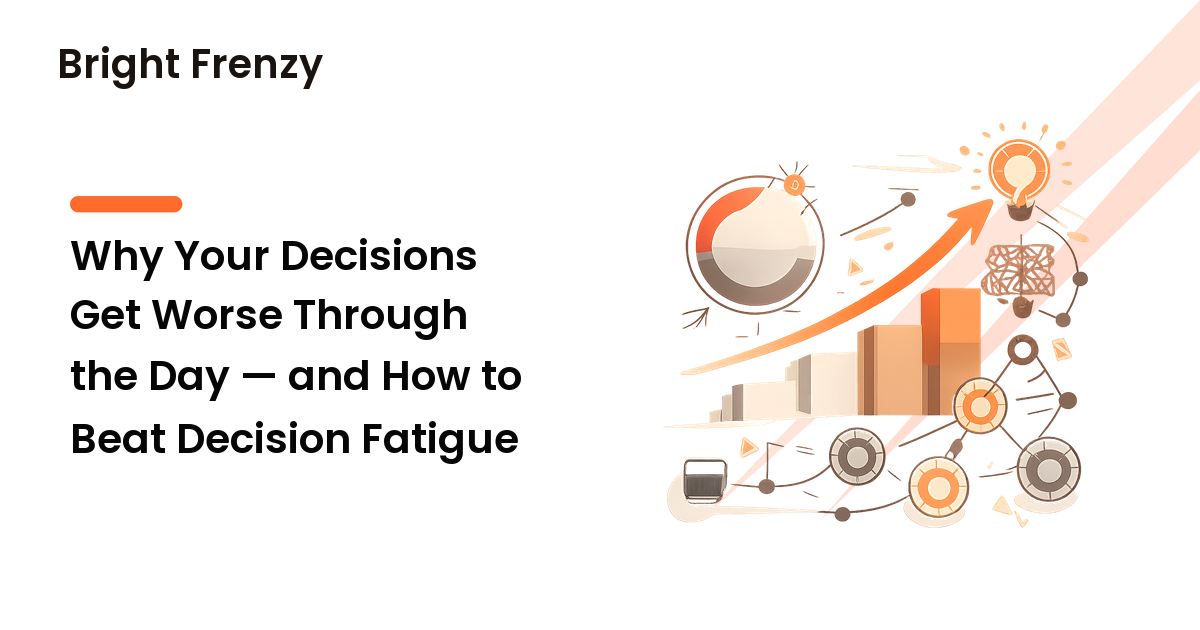
Decision fatigue is the decline in the quality of your decisions after a long run of choices. Think of your daily judgment as a battery, not a light switch. In the morning it's charged: you weigh options, resist the easy-but-wrong choice, and think a step ahead. As the day grinds on, the charge drops — and a drained battery shows up two ways.
First, you start avoiding decisions — deferring to "later," or letting the default win because choosing feels like too much. Second, you get impulsive — grabbing the fast, comfortable option just to make the deciding stop. Both are the same shortfall in different clothes — a kind of willpower depletion, where the self-control that powers a careful choice has simply run down. The mechanism matters because it says the problem isn't you; it's load.
A fair caveat: this is a tendency, not a law of physics, and it varies with sleep, food, and stress. This is general productivity guidance, not a clinical claim — if persistent afternoon fog, exhaustion, or low mood is affecting your life, raise it with a doctor, because plenty of medical causes have nothing to do with your calendar. But for the ordinary "scattered by 3pm" version, the lever is the same: stop spending judgment you don't need to spend.
Why your hardest work belongs early
If good decisions are a charged battery, the obvious move is to schedule your most demanding thinking for when the charge is highest — usually the first block of your day, before the small stuff has nibbled it down.
This is the strongest practical reason to protect your morning. It's not that mornings are magic; it's that you haven't yet spent the day's judgment on a hundred minor calls. The strategy paper, the hard conversation, the pricing call — anything where being right beats being fast — wants that fresh battery. Push it to late afternoon and you're more likely to take the lazy option and call it a decision.
The trade-off is honest: not everyone's peak is the morning, and some genuinely think best later. The rule isn't "mornings win" — it's "match your highest-stakes decisions to your highest-energy window, and defend that window." Fill your peak hours with email and Slack and you've spent premium fuel on errands. (If protecting that window is the hard part, the habits guide shows how to make a defended morning a default, not a daily negotiation.)
The fix: turn recurring decisions into defaults
If you want the one lever that matters most in how to beat decision fatigue, it's this: the cheapest decision is the one you've already made. Anything you decide fresh every day is a recurring withdrawal from the battery. The way to reduce decisions isn't to care less — it's to convert each repeating choice into a standing default so the withdrawal stops and the choice runs on autopilot.
This is why you'll hear about people wearing the same outfit daily or eating the same breakfast all week. The specifics are theatre; the principle is real: pre-decide the trivial, repeating stuff so it costs nothing later. A few high-leverage places, in order of payoff:
- Meals. The biggest small-decision sink for most people. A default breakfast or a short rotating dinner menu erases dozens of micro-choices a week. Best for: anyone who hits 6pm with no plan and orders out by default.
- What to work on first. Decide tonight, not tomorrow morning. Choosing the day's top task while you still have charge means you start on autopilot instead of burning the fresh battery deciding where to point it. Best for: people who lose their sharpest hour to "okay, what now?"
- Clothes and logistics. Pick tomorrow's outfit the night before; standardize the boring repeats. Best for: anyone whose mornings are a scramble of tiny choices.
- Routine yes/no requests. Set rules in advance — "no meetings before 11," "no calls on Fridays" — so you're applying a policy, not re-litigating each ask. Best for: people who say yes when tired and regret it later.
The order matters: start with meals and your first task, since those repeat daily and drain the most. The honest limitation is that defaults trade flexibility for energy — you give up some spontaneity to buy back judgment. For small, repeating decisions that never deserved deliberation, that trade is worth it.
A simple daily structure that respects the battery
You don't need an elaborate system — just a shape that spends judgment in the right order.
- Pre-load the night before. Settle tomorrow's top task, first meal, and clothes while today's leftover charge is going to waste.
- Front-load the hard thinking. Put your highest-stakes work in your peak window and guard it from meetings and messages.
- Batch the small stuff. Herd email, admin, and quick replies into a block or two. Each context switch is its own little decision; batching means you decide "now I do email" once, not forty times over.
- Put low-stakes, reversible calls late. Routine, easily-undone choices are what a tired battery can still handle. Just don't let a big irreversible decision land there by accident.
- Notice your dip and stop deciding into it. When the late-day slump hits, defer anything important to tomorrow's fresh battery rather than force a weak call now.
FAQ
What causes decision fatigue?
It builds from the sheer volume of choices you make, large and small, across a day — each drawing on the same limited pool of mental energy. The more decisions you stack up, the more depleted that pool gets. Poor sleep, skipped meals, and high stress make it worse by lowering your starting charge.
Is decision fatigue real or just an excuse?
It's a well-described pattern in how judgment degrades over a long run of decisions, not a license to coast. The point isn't to excuse bad choices — it's to prevent them by spending fewer decisions on trivia. Treat it as a design problem, not a personality trait you're stuck with.
How do I stop making so many small decisions?
Pre-decide them. Anything you face daily — meals, clothes, what to tackle first — can become a standing default you set once instead of choosing every morning. Build a short routine for the repeating stuff, and save fresh decision-making for choices that genuinely vary and matter.
Why am I sharp in the morning but scattered by afternoon?
Most likely because you've spent the day's decision capacity on a long string of small calls, leaving less for later — so you avoid choices or grab the easy option just to be done. Protecting your morning for hard work and batching the small stuff usually flattens that curve, though if the crash is severe or constant, rule out sleep and health factors with a professional.
Does willpower actually run out?
Treat it as a working model, not gospel: your self-control behaves as if it depletes over a demanding day, depending on rest, fuel, and how invested you are. You don't need to settle the science to use the takeaway — assume your judgment is a resource worth conserving, and give the important decisions the charged version of you.
Next step
Stop trying to out-discipline a drained battery and start spending fewer decisions on things that don't matter. Tonight, do three small things: choose tomorrow's most important task, decide your first meal, and lay out what you'll wear. That's three decisions you won't pay full price for in the morning — and three units of judgment saved for work that deserves them. Build the defaults that make this automatic at brightfrenzy.com.